


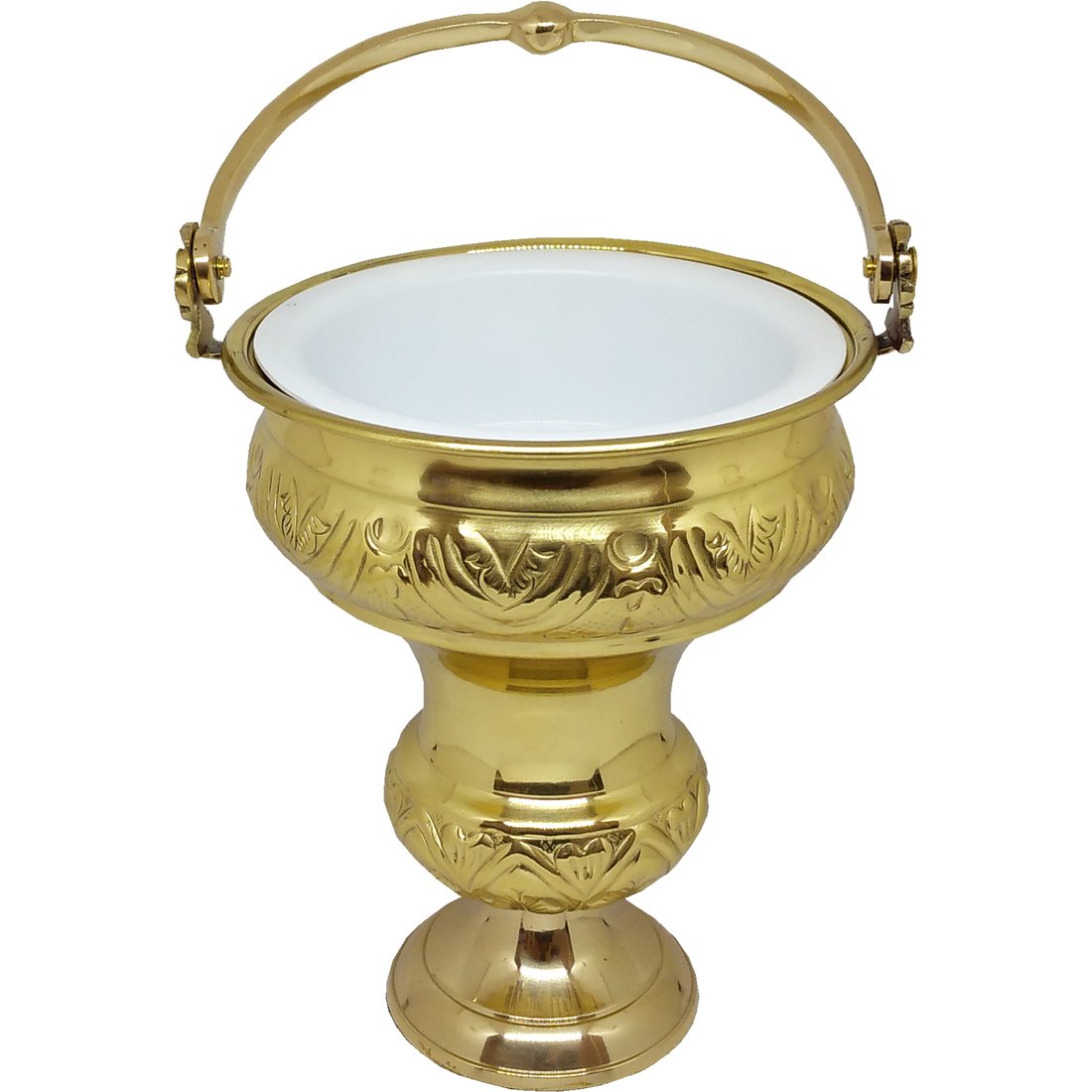
Golden acetre with chiselled base - 17.5 cm. Tall
180,00€
Taxes includedCatholic product in stock. Products ready to be shipped. You can check the approximate delivery time during the purchase process.
Holy water bucket and aspergillum
- Holy water bucket with 30 cm (11.81 in) total height.
- 20 cm (7.87 in) in height up to the handle.
- 16 cm (6.30 in) in diameter.
- Made of polished brass.
- Holy water bucket with a foot with relief decoration.
- Chiselled decoration with vegetal motifs on cup and stem.
- Holy water bucket with a removable inner bucket to facilitate cleaning.
- The sale price does not include the aspergillum.
- Also for sale liturgical holy water bucket and aspergillum set.
Liturgical holy water bucket and aspergillum
The holy water bucket and the aspergillum are a set of two pieces of liturgical metalwork that priests commonly use. The holy water bucket is the vessel that contains the holy water. The aspergillum is the instrument with which the priest sprinkles (spreads) the holy water over people, places, or objects.
Holy water is a symbol of purification, divine protection and, very especially, the memory of baptism.
In its most common form, the holy water bucket is a bucket or pail with a handle, designed to carry the water with stability and without spills. The aspergillum, for its part, is usually a structure with a handle joined to bristles or a perforated reservoir, generally spherical in shape, which stores the water and lets it fall when one shakes it gently.
In some local traditions or solemn celebrations, the aspergillum can also be a bunch of branches (boxwood, laurel, or others), recalling ancient forms of sprinkling, before the metal models that are used nowadays became widespread.
These objects are used above all in blessings and in rites of purification. The gesture of sprinkling with holy water is a reminder that God sanctifies, protects, and calls to conversion. Holy water evokes for us baptismal grace, the request for purification and the supplication for divine protection.
Etymology of the holy water bucket and aspergillum
- Acetre (Holy water bucket)
In Hispanic liturgical usage, the word acetre refers to the vessel for holy water intended for sprinklings. The word's origin is related to the Latin term sítula, which means "bucket" or "small cauldron".
The acetre contains and carries the holy water.
- Hisopo (Aspergillum)
The term hisopo refers to a plant (very present in biblical language) which, according to Sacred Scripture, was used to carry out rituals related to blessing.
The hisopo allows one to sprinkle in an orderly and visible manner.
History, origin and evolution of use
Sprinkling with water as a sign of purification has a very ancient background: in the Bible, rites with water (and also with blood) appear associated with purification and with the covenant. With the passing of the centuries, the Church shaped the use of holy water in celebrations and blessings, and with this the use of vessels and "aspersoria" became established.
During the Middle Ages, in addition to metal instruments, the use of branches or vegetal bunches for sprinkling is documented. Over time, more stable forms prevailed: the aspergillum with bristles or with a perforated reservoir, and the holy water bucket as a portable and resistant small cauldron, suitable for the service of the altar and for processions or blessings outside the church.
Method of use (how it is used in practice)
- One places the holy water in the holy water bucket.
- The celebrant takes the aspergillum and introduces it briefly into the holy water bucket to load it with water.
- One sprinkles with a short and controlled gesture, normally with a movement of the wrist, avoiding soaking and seeking a dignified dispersion. The gesture seeks to be sober and expressive at the same time.
- After use, one leaves the aspergillum in a suitable place (sometimes next to the holy water bucket), taking care that it does not drip on the floor or on the corporals.
Usual moments of use
1) Sunday sprinkling at Mass. On some Sundays, especially during the Easter season, sprinkling with holy water can replace the Penitential Act, underlining the memory of baptism and the call to live as the baptised.
2) Exequies (funeral). Sprinkling over the coffin (and sometimes over the assembly) expresses Christian hope and recalls that the deceased was incorporated into Christ through baptism.
3) Blessings of people, places or objects. It is frequent in blessings of houses, in certain rites of dedication or blessing of spaces, and in blessings of devotional objects, when the ritual provides for it.
