


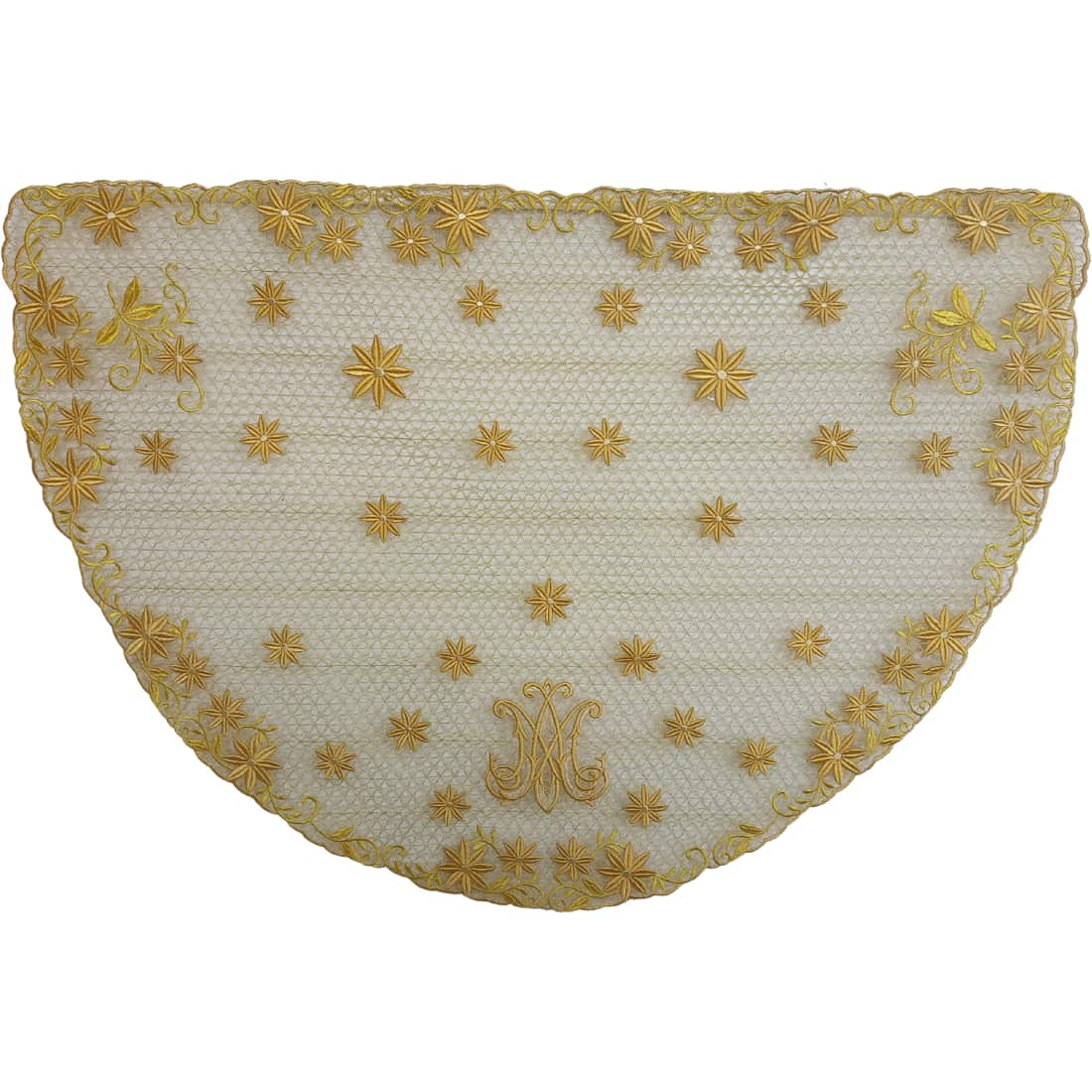
Mantle veil with flowers and Ave Maria (Hail Mary)


815,00€
Taxes includedCatholic product in stock. Products ready to be shipped. You can check the approximate delivery time during the purchase process.
Mantle veil with flowers and Ave Maria (Hail Mary)
- Mantle veil embroidered on golden polyester mesh.
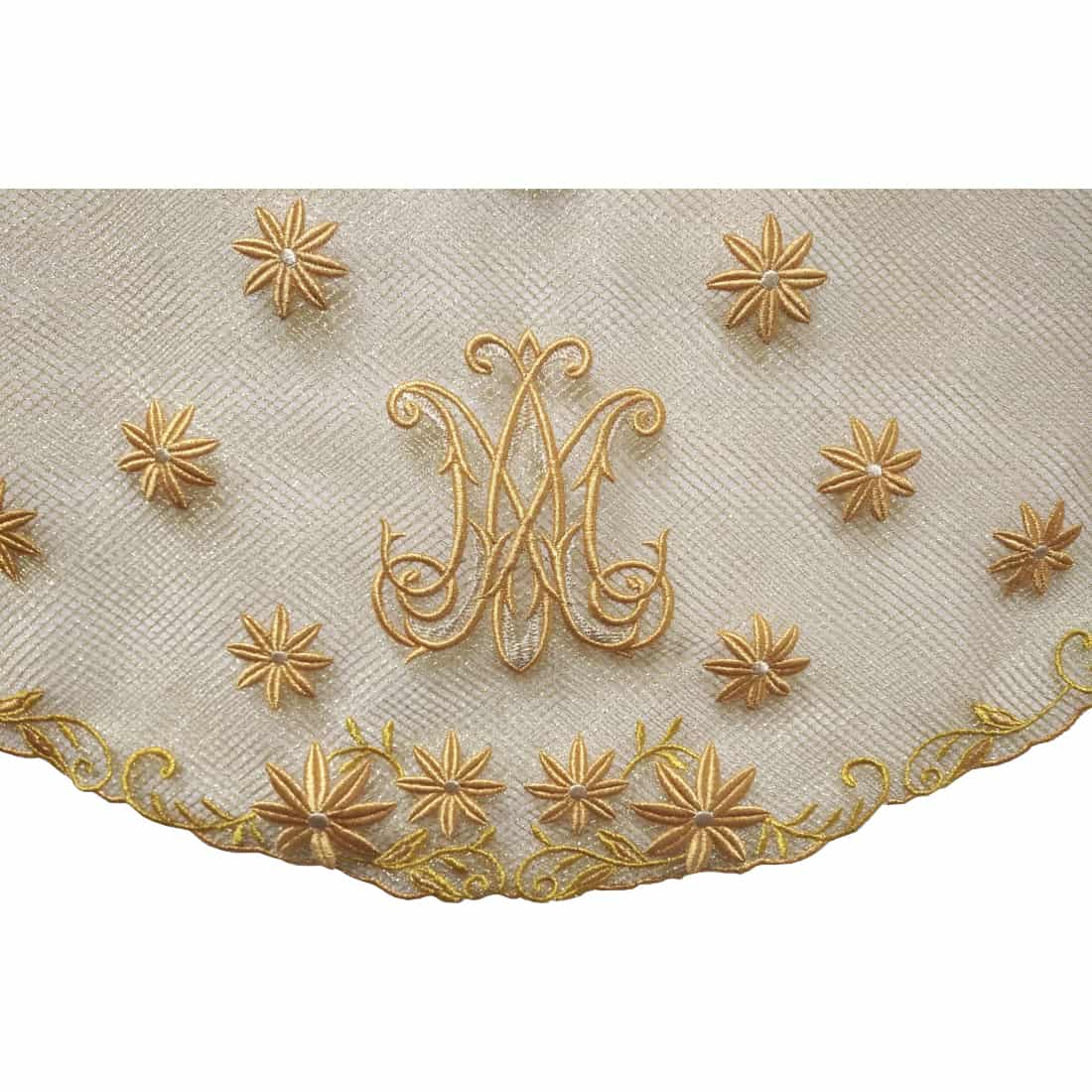
- Golden floral embroidery in raised metallic thread.
- Central Ave Maria monogram (Hail Mary).
- Approximate size 75 x 110 cm (29.53 x 43.31 in).
- Embroidered perimeter border and symmetrical composition.
- Also available: other embroidered mantles for religious statues.
What is a mantle veil?
A mantle veil is an ornamental textile piece that accompanies the outer mantle of a Marian image. It is placed over the main mantle or over the outer mantle of a dressed statue. Its purpose is to enrich the visual presentation of the trousseau, reinforce the decorum of the image and provide a clearer symbolic reading when the design includes Marian or devotional motifs.
The mantle veil performs a function of visible and orderly adornment over the textile ensemble of a Marian image. It does not replace the spiritual value of the image or alter its devotional identity, but it does help to present the trousseau with greater visual richness.
In this model, the symbolic meaning is concentrated in two very clear elements. The first is the Ave Maria monogram, which identifies the piece as a Marian complement and immediately directs its use towards an image of Our Lady.
The second is the golden floral embroidery, distributed symmetrically across the surface and the border, which introduces a sense of light, delicacy and solemnity. For that reason, the term mantle veil does not refer only to a textile accessory, but to a devotional presentation element with recognisable meaning.
History and origin
The history and origin of mantle veils are best understood within the tradition of the trousseau of dressed statues. In the Hispanic world, many Marian images have been elegantly adorned with mantles, outer mantles, veils and other textile complements that accompany popular veneration. This practice does not arise from an isolated fashion, but from a devotional culture that values visible beauty as an expression of respect, solemnity and continuity with the memory of the believing community.
This historical development cannot be separated from the doctrinal foundation of sacred images. The Catechism of the Catholic Church recalls that, from the mystery of the Incarnate Word, the Second Council of Nicaea, held in the year 787, justified Christian veneration of sacred images. The vesting of a sacred image should aim to support veneration, presenting the figure with dignity rather than seeking mere aesthetic display.
The Directory on Popular Piety and the Liturgy reinforces this line by recalling the cultic significance of images blessed and intended for public veneration. The Directory itself reminds us that the mantle veil takes on its meaning as a piece subordinate to the image, not as an autonomous protagonist of the ensemble.
Features and use of the veil
The features and elements of this piece are clear and verifiable. The base is formed by golden polyester mesh, a lightweight support that gives a more airy visual fall than other, more compact fabrics.
On this base, the raised metallic gold embroidery is arranged, worked with a floral design of continuous presence.
The composition stands out for the ordered repetition of small and large flowers, for the embroidered border that runs around the edge and for the central Ave Maria monogram positioned in the lower area.
The practical use of this mantle veil depends on its harmony with the base mantle and the size of the image. This piece gives Marian vesture a balanced presence when the aim is to enrich the ensemble without completely covering the main fabric. The light mesh allows flexible placement, while the raised embroidery helps the design remain legible from a distance.
Types of mantle veils
The types and variants of mantle veils are usually differentiated by size, base fabric, mesh colour, richness of embroidery and the presence of explicit symbols. There are more restrained models, centred on a light border or repeating motif, and others that are denser, with scrollwork, flowers or prominent Marian symbols.
They also vary according to the practical destination of the piece: a small image does not require the same visual presence as a larger composition, which is why size is as relevant a criterion of choice as design.
