


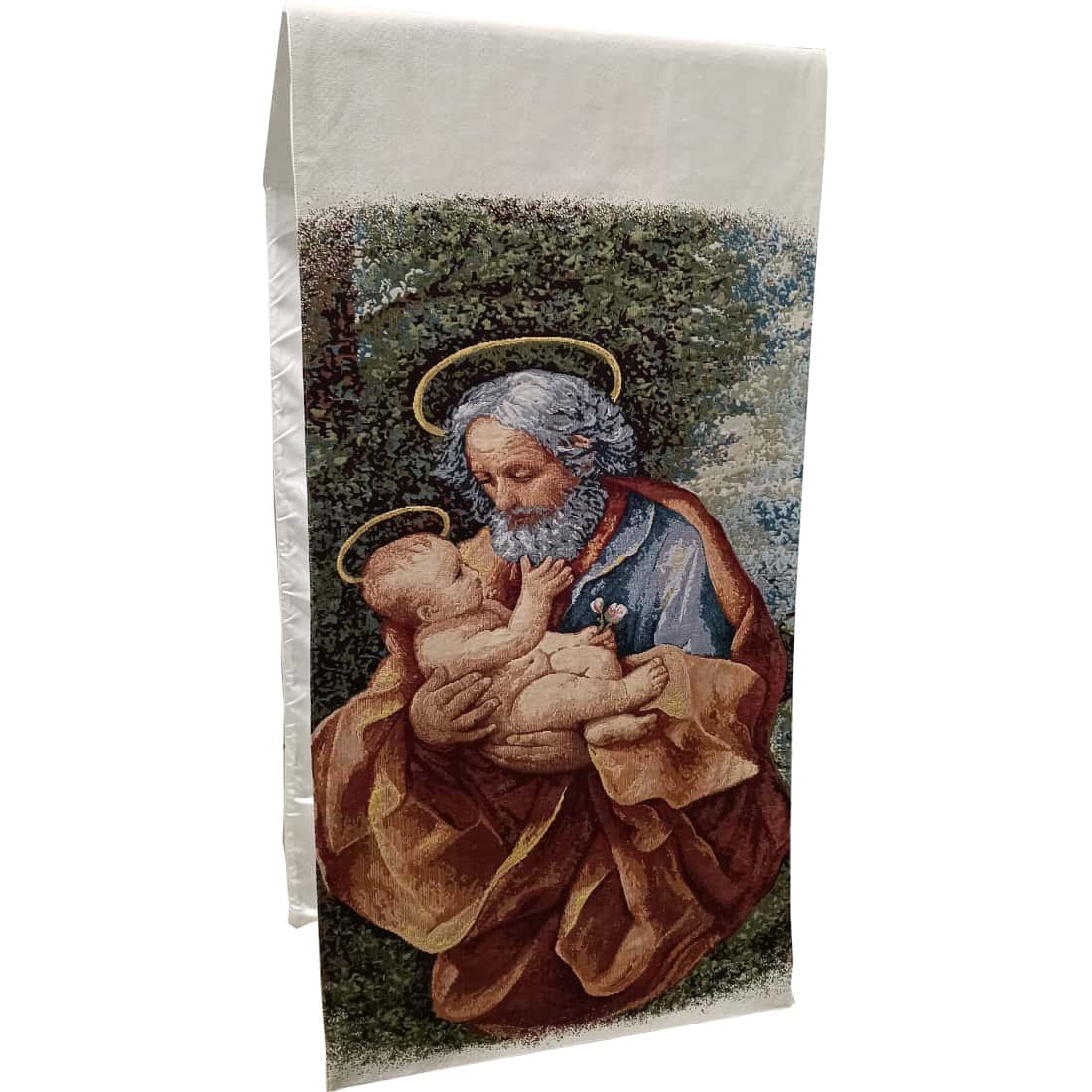
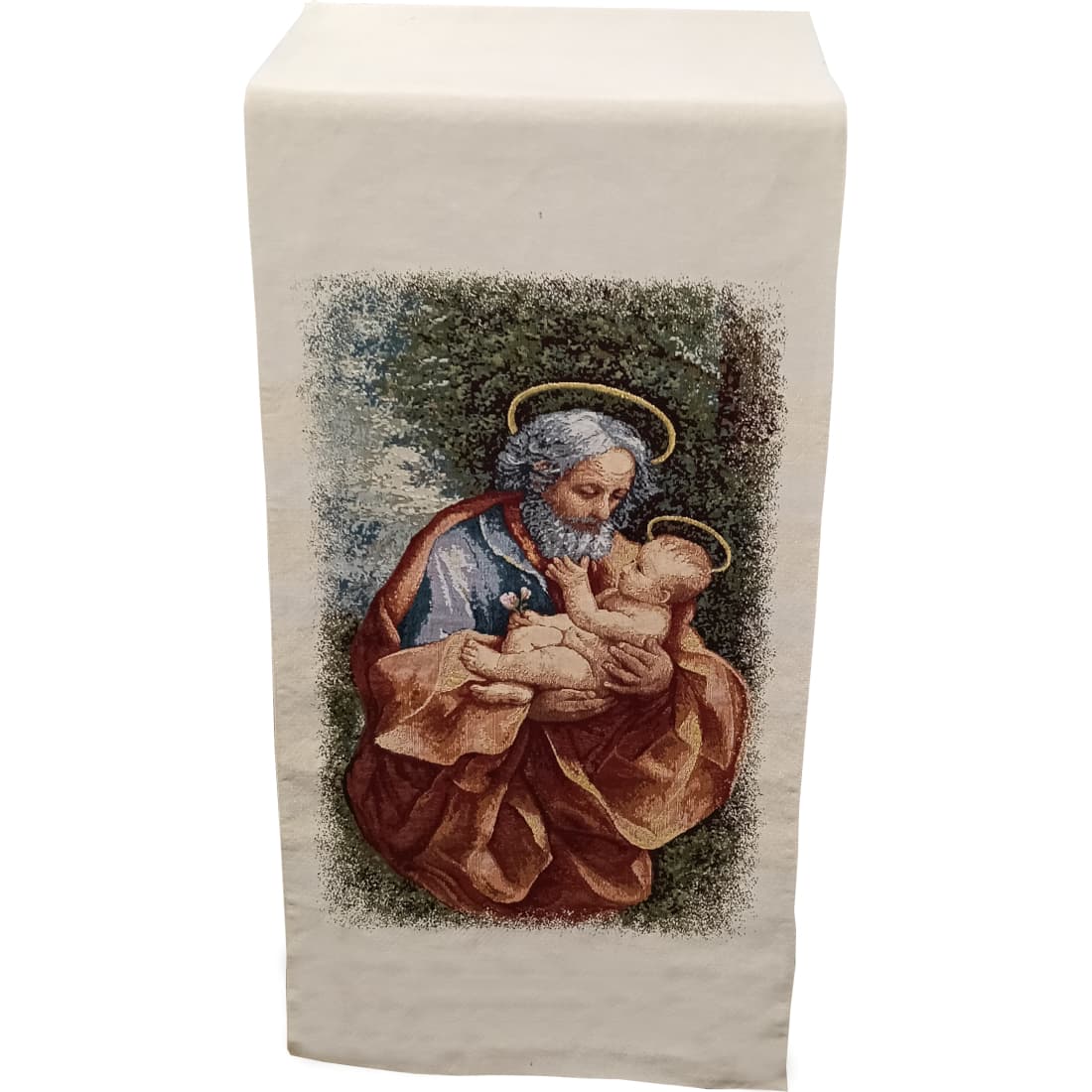
Ambo cover | Saint Joseph with Child Jesus


165,00€
Taxes includedCatholic product in stock. Products ready to be shipped. You can check the approximate delivery time during the purchase process.
Ambo cover image of Saint Joseph with the Child
- Ambo cover with image of Saint Joseph with the Child Jesus.
- Beige colour.
- Made of viscose and polyester.
- 55 cm (21.65 in) wide by 230 cm (90.55 in) long.
- Inner lining.
- Decorated with image on the front and back.
- Other liturgical ambo covers for sale.
Embroidery of the lectern cloth: Saint Joseph with the Child Jesus by Guido Reni
The image of the ambo cover is inspired by the celebrated painting Saint Joseph with the Child Jesus by the Italian master Guido Reni (1575-1642), made around 1635 and currently kept in the Hermitage Museum of Saint Petersburg, Russia.
Guido Reni, known as "il Divino" by his contemporaries, was one of the most influential painters of the European Baroque. Trained at the prestigious Bolognese School under the guidance of the Carracci brothers, he developed a style that combined Renaissance classicism with the emotiveness of the Baroque.
His famous work Saint Joseph with the Child Jesus is an oil on canvas (126 x 101 cm (49.61 x 39.76 in)) and it represents Saint Joseph holding the Child Jesus with a gesture of great tenderness. He looks at him with love and devotion. The Child turns towards Saint Joseph with an affectionate gesture, touching his beard. Jesus is serene in Saint Joseph's arms; he trusts him completely.
The Italian artist creates the effect of paternal-filial intimacy by employing a refined chiaroscuro and a warm palette of ochres, whites, and reds. The soft brushwork and delicate glazes create an atmosphere of heavenly serenity.
The painting reflects the iconographic transformation of Saint Joseph during the Catholic Counter-Reformation. If previously the saint was represented as a secondary figure, the Council of Trent and the devotion of Saint Teresa of Ávila promoted a new image: Saint Joseph as a model of loving fatherhood, conjugal fidelity, and Christian humility.
The figure of Saint Joseph in the Catholic Church
The figure of Saint Joseph and his role in the rites of the Catholic Church have evolved over the years.
In the first centuries of Christianity, theological and liturgical attention focused almost completely on Christ and, secondly, on the Virgin Mary. Saint Joseph appeared, had very little presence in liturgical celebrations and, therefore, in the artistic representations of the time. On the occasions when he was represented, especially throughout the Middle Ages, he used to appear in Nativity scenes, scenes of the Bethlehem crib, as an elderly man set apart, slightly distant.
The Church and, by extension, the artists who made this type of work tried to evangelise the faithful by highlighting that Saint Joseph was not the biological father of Jesus, making evident the importance of the doctrine of Mary's virginity.
From the 16th century onwards, with the Counter-Reformation and the Council of Trent, the figure of Saint Joseph was vindicated by a new current of theologians and saints such as Teresa of Jesus.
This new group managed to see the true role that God had reserved for Saint Joseph: a faithful husband, a tireless worker, and a responsible father. The new vision led to the establishment of a high number of new feasts dedicated to the saint, confraternities, parishes dedicated to his devotion, etc.
As for artistic representations, Saint Joseph becomes the protagonist in a significant number of paintings, Catholic statues, tapestries, etc. In many of those Catholic works, artists represent Saint Joseph with the Child Jesus, to highlight his role as father, working in his workshop or guiding the Holy Family.
The importance of Saint Joseph is consolidated in the 19th and 20th centuries. The popes deepened this revaluation: Pius IX declared him Patron of the universal Church on 8 December 1870 through the decree Quemadmodum Deus, stating that just as he protected Jesus and Mary in Nazareth, he now protects the Body of Christ which is the Church.
